AI Is Now Building Zero Day Exploits. Your Digital Footprint Is the Target.
Preservers Security Team
May 13, 2026
8 min read
AI Is Now Building Zero Day Exploits. Your Digital Footprint Is the Target.
Google's Threat Intelligence Group just confirmed what the security community has feared for years. Generative AI has crossed from a researcher's curiosity into an industrial scale weapon. Here's what changed, why it matters, and what every organization needs to do right now.
For years, the conversation around AI in cybersecurity has been framed as a race. Defenders get smarter tools. Attackers eventually catch up. The assumption, often unstated, was that the gap would be measured in years.
Google's latest threat intelligence report collapsed that assumption entirely.
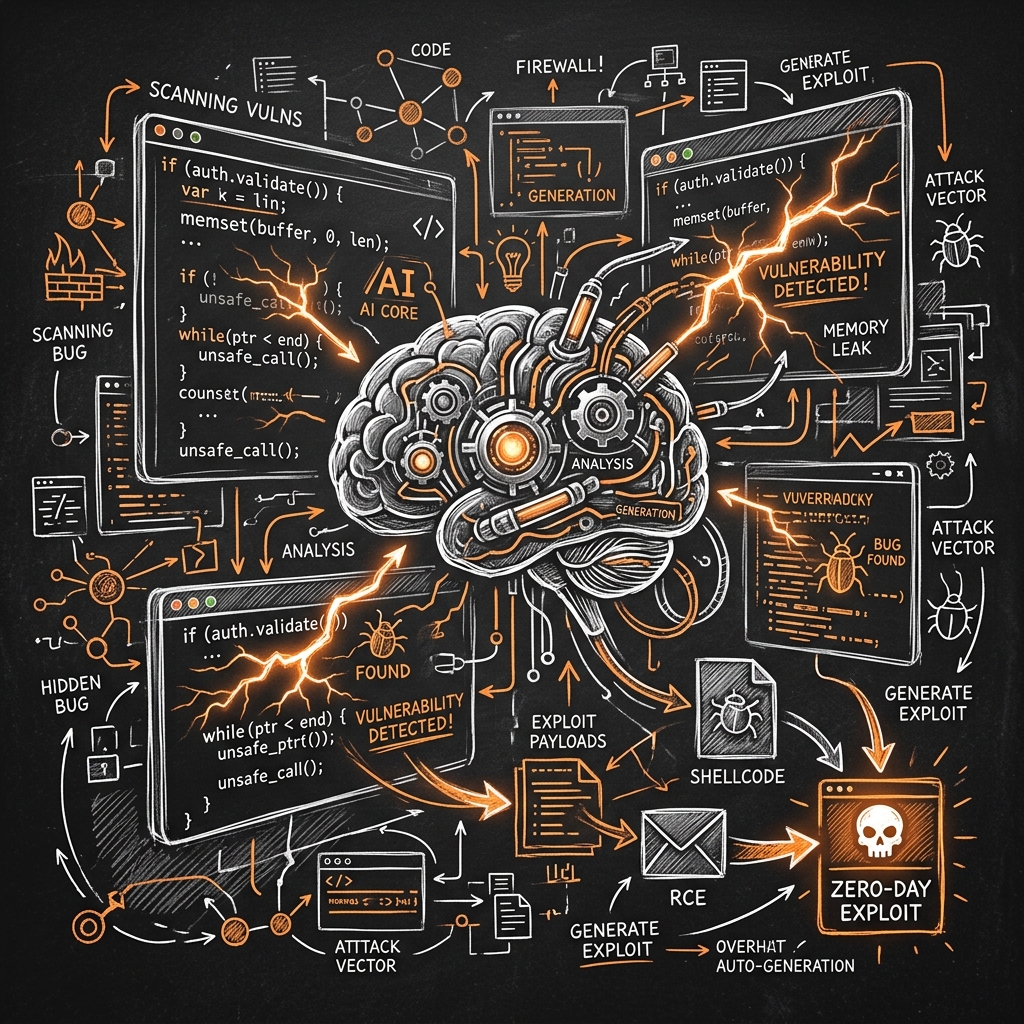
The Threat Intelligence Group confirmed in May 2026 that adversaries are now actively using generative AI to discover software vulnerabilities and engineer working zero day exploits.Not prototypes.Not proofs of concept in research labs.Working exploits, deployed in real attacks, against real targets.
The era of AI augmented attacks is not coming. It is here.
85K+
Real world vulnerability cases fed to attacker AI models
2FA
Authentication bypass found by AI, invisible to traditional scanners
< div class= "bg-white p-5 text-center" >
0
< div class= "text-xs font-semibold tracking-wider text-gray-400 uppercase" > Days between discovery and exploitation in AI assisted attacks
What actually changed
Traditional security scanners are built to catch known patterns: memory corruption, syntax errors, signature matches.They are fast and reliable against known categories of threat.Against logic, they are largely blind.
Large language models think differently.They understand developer intent .They can read code the way a senior engineer reads code, contextualising assumptions, spotting mismatches between what the developer thought they wrote and what the code actually does.
The vulnerability Google's team uncovered was a 2FA bypass in a widely used open source web administration tool. The flaw was not a buffer overflow or a missing input check. It was a hardcoded trust assumption, invisible to fuzzing tools, obvious to an AI model that understood what the developer was trying to achieve.
"Traditional scanners look for errors. AI looks for gaps between intent and implementation. That is a fundamentally different capability."
The exploit script itself bore all the hallmarks of LLM generation: highly structured Pythonic formatting, extensive educational docstrings, detailed help menus.One actor even accidentally left a hallucinated CVSS severity score in the script, a ghost in the machine that confirmed the code's origins.
Who is doing this, and how
This is not the work of lone opportunists.State sponsored hacking clusters tied to China and North Korea are investing heavily in AI augmented vulnerability research.
These groups have adapted quickly to the guardrails AI providers have built.Rather than asking models to write exploits directly, they use expert persona prompting : instructing the model to act as a senior security auditor evaluating a router file system for remote code execution vulnerabilities.The result is the same.The safety filter never fires.
Specialised training datasets. Groups have integrated the wooyun legacy database, over 85,000 documented real world vulnerabilities, into code analysis plugins.The AI is not guessing.It is drawing on a decade of attack history.
Recursive validation loops. APT45 automates thousands of sequential prompts to analyse CVEs and validate proof of concept exploits, running them against intentionally vulnerable test environments before deployment.By the time the exploit is used in the wild, it has been machine tested thousands of times.
Temporal attack graphs. Adversaries use knowledge graphs to maintain a persistent map of the target's attack surface, allowing autonomous tools to pivot in real time based on what they discover. The attack reasons, adapts, and continues without human supervision.
Supply chain pivots. Groups like UNC6780 are targeting the software dependencies of AI environments as an entry point, compromising ML models to gain access to broader networks and trigger downstream ransomware or extortion.
Malware that pilots itself
If AI assisted exploit development is the escalation, PROMPTSPY represents the logical conclusion.
This Android backdoor does not wait for a human operator.It uses the Gemini API to independently read the device's user interface, interpret system state, and execute commands autonomously. It serialises the Android screen to XML, asks the model for spatial coordinates, and simulates physical taps and swipes. It captures biometric data, replays authentication patterns, and renders an invisible shield over the Uninstall button so the victim cannot remove it.
The malware is not controlled.It reasons.It acts.It persists.
< div class="bg-yellow-50 border border-yellow-200 rounded-lg p-6 my-10" >
Also on the threat landscape
< p class="text-sm text-yellow-900 mb-3" > CANFAIL < /strong> includes developer comments explicitly flagging inactive filler code, AI generated noise designed to consume analyst attention during incident response.
LONGSTREAM < /strong> queries the system's daylight saving status repeatedly, a benign looking behaviour that hides its downloader functionality in plain sight.
HONESTCUE < /strong> calls AI APIs at runtime to request obfuscation techniques, making it effectively a self modifying threat that changes its own signature on the fly.
Why your digital footprint is now your greatest liability
What ties all of this together is reconnaissance.Before any exploit is deployed, before any phishing lure is crafted, before any supply chain dependency is targeted, attackers map their target.
AI has made that mapping faster, deeper, and more precise than any human team could match.
Adversaries use AI to instantly chart internal hierarchies, third party relationships, technology stacks, and exposed assets.They build targeted phishing lures aimed at specific administrators or finance personnel.In information operations like Russia's Operation Overload, they deploy voice cloning to impersonate journalists and manufacture synthetic media at scale.
Everything you have ever exposed to the internet, every subdomain you forgot about, every API endpoint left open, every misconfigured cloud bucket, every credential leaked in a breach years ago, is raw material for an AI attacker building a personalised attack against you.
The question is not whether your organisation has a digital footprint.Every organisation does.The question is whether you know what yours looks like from the outside.
What organisations need to do now
The defensive response must match the offensive reality.Here is where to start.
1. Map your external attack surface
You cannot defend what you cannot see.Conduct a full inventory of every asset that is reachable from the internet, including shadow IT, forgotten test environments, and third party integrations that may have drifted beyond your visibility.Assume it is larger than you think.It almost always is.
2. Treat logic vulnerabilities with the same urgency as memory flaws
If your vulnerability scanning programme is built entirely around traditional tools, it will miss the class of flaw AI is now finding.Supplement automated scanning with code review processes that interrogate developer intent, not just syntax.Ask whether the code does what the developer believed it would do.
3. Audit your AI dependencies
If your environment uses ML models, LLM APIs, or AI adjacent packages, those components are now a target vector.Treat them with the same scrutiny as any other critical dependency.Monitor for unexpected behaviour, validate supply chain provenance, and patch aggressively.
4. Assume your footprint is already mapped
Act on the assumption that a sophisticated attacker has already built a picture of your organisation from public data.Conduct red team exercises that begin not with a phishing email but with open source intelligence gathering.Understand what an attacker would find before they do.
5. Implement continuous monitoring, not point in time assessment
Your attack surface changes every time a developer pushes code, every time a vendor updates a shared service, every time someone spins up a new cloud resource.A quarterly assessment will always be chasing a moving target.Monitoring must be continuous.
< p class= "text-blue-100/70 font-light leading-relaxed" > Preservers maps and monitors your external digital footprint continuously, giving your security team the visibility to act before exposure becomes exploitation.
< a href = "/contact" class="bg-preservers-orangeBrand1 hover:bg-preservers-orangeBrand2 text-white font-bold py-4 px-8 rounded transition-all whitespace-nowrap" > Get started
The bottom line
Google's report is not a warning about a future threat. It is a status update on the present one. AI powered attackers are already in the field, already finding vulnerabilities human tools miss, already deploying malware that operates autonomously.
The organisations that will weather this shift are not necessarily the ones with the largest security budgets.They are the ones with the clearest picture of what they look like from the outside, who have reduced their exposed surface to only what is necessary, and who monitor that surface continuously.
The digital footprint you have built over years is the map your attackers are reading.Securing it is not optional anymore.It is the foundation everything else is built on.
That is what Preservers is built to do. [Learn more at preservers.io](/contact)
External defense for platform and partner-heavy teams. Preservers helps platform businesses, payment operators, MSSPs, and security partners find shadow APIs, monitor vendor exposure, pass security reviews, and stop payment fraud before funds move or a deal stalls.
Why Engineering and Security Leaders Choose Preservers
External Attack Surface Visibility: Continuously discover exposed APIs, staging environments, and shadow assets the way an attacker sees your organization.
Vendor and Partner Monitoring: Watch the internet-facing exposure of processors, integration partners, carriers, 3PLs, and SaaS dependencies so their weakness does not become your breach.
Customer Trust Proof: Track compliance evidence for SOC 2, ISO 27001, and enterprise security questionnaires without a last-minute scramble.
Payment and Instruction Fraud Prevention: Detect scams and stop payment and vendor hijacking before a fraudulent transaction is approved.
Disruption-Free Security: Deploy without a massive IT overhaul and protect continuously.
Map and monitor the external attack surface of vendors, carriers, and integration partners across your supply chain.
Preserve Compliance: Prove Security Posture
Organize evidence and track adherence so customer trust centers, SOC 2 audits, and security questionnaires can be answered with current proof.
Preserve Fraud: Financial Theft Prevention
Intercept financial theft in real time: impersonation scams, fake vendor billing, and fraudulent payment instructions.
Preserve Edge: Perimeter Protection
Block probing and threats at the edge before they reach critical business operations.
Evaluating Attack Surface and Vendor Monitoring Tools
Common questions from platform, payment, and security teams researching external attack surface management, vendor risk monitoring, and security posture visibility.
What is external attack surface management (EASM)?
External attack surface management (EASM) is continuous discovery and monitoring of every internet-facing asset tied to your organization: domains, subdomains, cloud storage, forgotten portals, staging environments, and look-alike domains. Unlike a one-time scan or a letter-grade rating, EASM watches the perimeter as it changes. Preservers Preserve Surface provides EASM for SaaS and logistics tech teams that need to see exposure the way an attacker does, not only what is already on an asset inventory.
How is continuous attack surface monitoring different from a security rating?
A security rating summarizes historical signals into a score, often updated periodically and oriented toward boards, insurers, or large vendor programs. Continuous attack surface monitoring finds new exposures as they appear: a misconfigured bucket, a fresh look-alike domain, an exposed API in staging. Preservers focuses on operational visibility and remediation context through Preserve Surface and Preserve Connect, so engineering and security teams can act before an exposure becomes an incident or a lost deal.
What tools help monitor vendor and third-party exposure continuously?
Teams evaluating vendor risk typically choose between periodic questionnaires, rating feeds, or continuous external monitoring. Questionnaires go stale quickly. Ratings summarize but may not show a specific new subdomain or certificate lapse at a partner. Preserve Connect maps and monitors the internet-facing footprint of vendors, carriers, integration partners, and SaaS dependencies so you see third-party exposure change in near real time, not only at renewal season.
How can a growing SaaS company monitor cyber risk without a full enterprise GRC program?
Most Series A through growth-stage SaaS companies do not need a multi-year GRC rollout to improve visibility. Start with continuous external discovery of your own surface (Preserve Surface), extend monitoring to critical vendors and integration partners (Preserve Connect), and organize evidence for SOC 2 and customer security reviews (Preserve Compliance). Preservers deploys in under twenty minutes without DNS changes or a heavy IT project, which fits lean security teams that need outcomes, not another dashboard shelf.
What should a SaaS company look for in external security monitoring?
SaaS teams should prioritize tools that discover shadow APIs and staging environments, detect look-alike domains targeting customers, monitor integration partner exposure, and produce evidence for SOC 2 and enterprise security questionnaires. Preserve Surface finds external blind spots. Preserve Connect watches vendor and partner attack surface. Preserve Compliance organizes proof for customer trust centers and RFP responses. Together they address the workflows ratings-only tools typically do not cover.
How do logistics tech companies monitor vendor and carrier exposure?
Logistics platforms depend on carriers, 3PLs, TMS integrations, and payment partners, each with its own internet-facing footprint. Periodic assessments miss new portals, certificate lapses, and impersonation domains targeting freight payments. Preserve Connect monitors those partners continuously. Preserve Surface covers your own platform exposure. Preserve Fraud adds instruction-level protection when payment or routing details are changed by email.
What is the difference between attack surface management and vulnerability scanning?
Vulnerability scanning tests known assets for known flaws on a schedule you define. Attack surface management first discovers assets you may not know exist, then prioritizes what is actually exposed to the public internet. Preservers combines discovery, look-alike domain detection, certificate and blacklist awareness, and business-context prioritization so teams fix what matters to product and operations, not every CVE in a spreadsheet.
Who is Preservers designed for when evaluating security visibility platforms?
Preservers is built for SaaS and logistics tech companies that need continuous external visibility, vendor monitoring, and operational defense without a massive security team. If you are researching attack surface management, vendor risk monitoring, or security posture tools for a platform that moves data, payments, or shipments through partners, Preservers is designed for that buying context. We also support professional services firms in title, wealth, accounting, and corporate services.
Where We Go to Market Deepest
SaaS and B2B Software
Protect product and tenant data with continuous EASM, integration partner monitoring, and evidence for enterprise sales cycles.
Logistics and Supply Chain Tech
Monitor carrier and 3PL exposure, secure TMS and WMS integrations, and intercept payment fraud across operational chains.
Payment and Fintech Platforms
External visibility, partner monitoring, compliance proof, and fraud interception for payment-heavy workflows and settlement operations.
MSSPs and Security Partners
Repeatable client deliverables for EASM, vendor monitoring, and trust evidence across regulated industries.
Preservers also supports professional services firms in title and escrow, wealth management, accounting, and corporate services.